
Flowers on black with flash and a diffuser
How the tulip photos against a black background are made – with a speedlight, a home-made diffuser and 1/250 s, f/16, ISO 100.
The tulips against black in my Flowers series were made without a studio or a black card. The light comes from a speedlight with a diffuser. The exposure is set so that the ambient light adds almost nothing to the picture, which is why the background turns black. I photographed the purple and white tulip further down in the Weihenstephan Trial Garden.
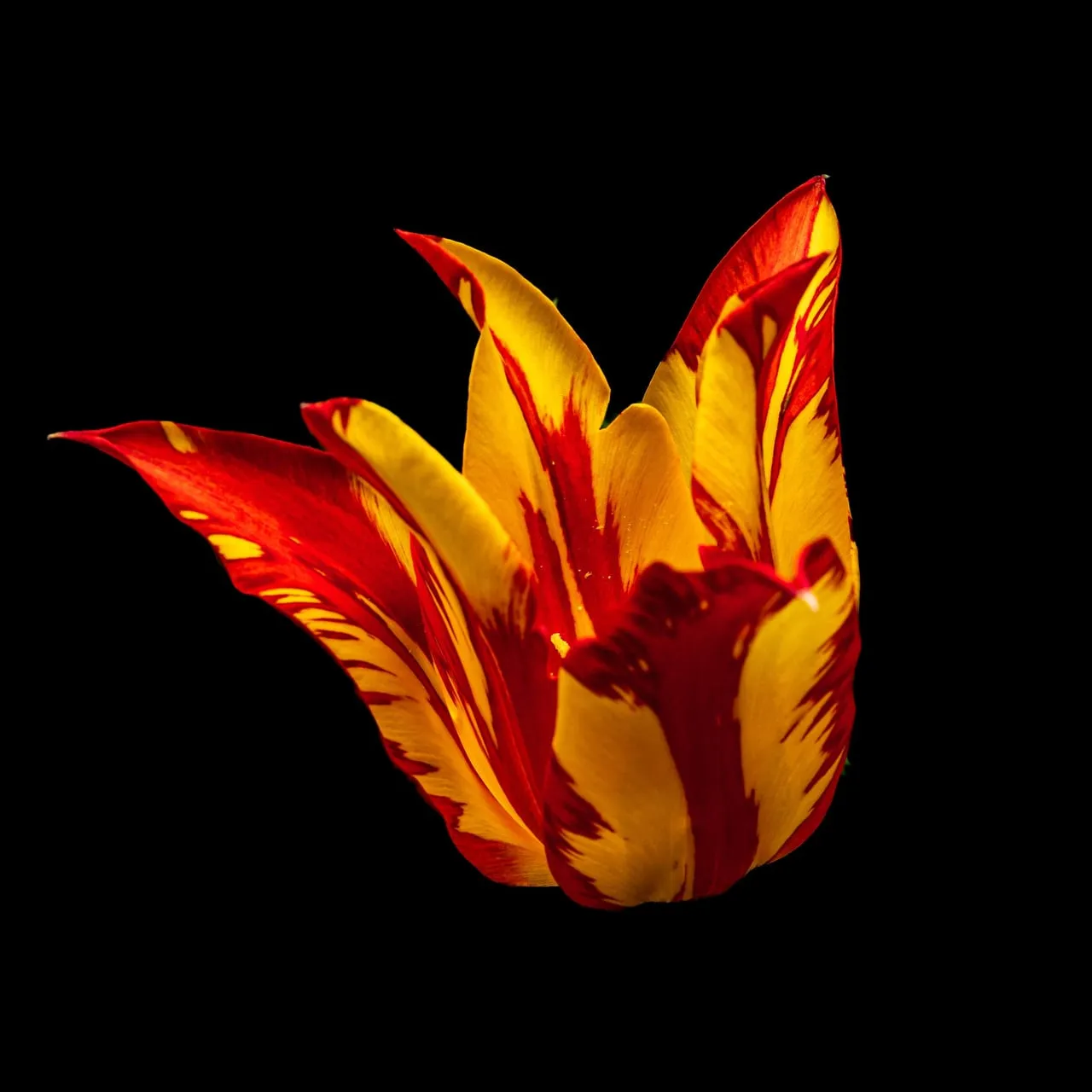 Red and yellow flamed tulip · Canon EOS R6, RF 35 mm F1.8 Macro · 1/250 s · f/16 · ISO 100
The principle
Every flash photo is two exposures in one: the ambient light and the flash. How bright the ambient light comes out depends on shutter speed, aperture and ISO. The flash, on the other hand, is so short that the shutter speed doesn’t affect it. What counts for the flash is aperture, ISO, flash power and distance.
At 1/250 s, f/16 and ISO 100 the ambient light is held back so far that it hardly contributes to the picture. The flower gets its light almost entirely from the flash, just a few centimetres away. Everything behind it stays dark, because flash light falls off with the square of the distance: a background twice as far away gets a quarter of the light, four times as far away a sixteenth.
The background won’t turn black on its own, though. By the sunny 16 rule, f/16 at ISO 100 and 1/100 s is a correct exposure in full sun. At 1/250 s a sunlit background is only a little more than one stop darker and stays visible. So look for flowers with shade or plenty of space behind them, and choose an angle that keeps the sky and other bright areas out of the background. Overcast days make it easier.
The settings
- M mode: fix shutter speed, aperture and ISO, otherwise the camera’s automatic exposure brightens the ambient light again.
- 1/250 s: the shortest shutter speed at which the camera still syncs with normal flash. Depending on the camera and shutter type this is 1/200 s or 1/250 s; the manual lists it as the flash sync speed. Anything faster needs high-speed sync (HSS), which costs a lot of flash power.
- f/16: cuts the ambient light and adds depth of field, which is always short at close range. For my tulips the aperture was between f/14 and f/18. Stopping down further makes the image softer through diffraction.
- ISO 100: as little ambient light and noise as possible.
- Flash: as close to the flower as you can get. E-TTL works, but all the black in the frame tempts the metering into more power, and pale flowers blow out. Dialling in negative flash exposure compensation helps. In manual flash mode the brightness stays the same from shot to shot; two or three test shots are enough to find the right power.
Why a diffuser
A bare speedlight is a small light source. It gives hard shadows and harsh highlights, especially on wet petals. At close range it also fires over the lens and barely reaches the flower right in front of it. A diffuser makes the lit area larger and brings it forward, close to the flower. The larger and closer that area, the softer the light. Both of my diffusers are home-made.
Funnel on the RF 35 mm Macro
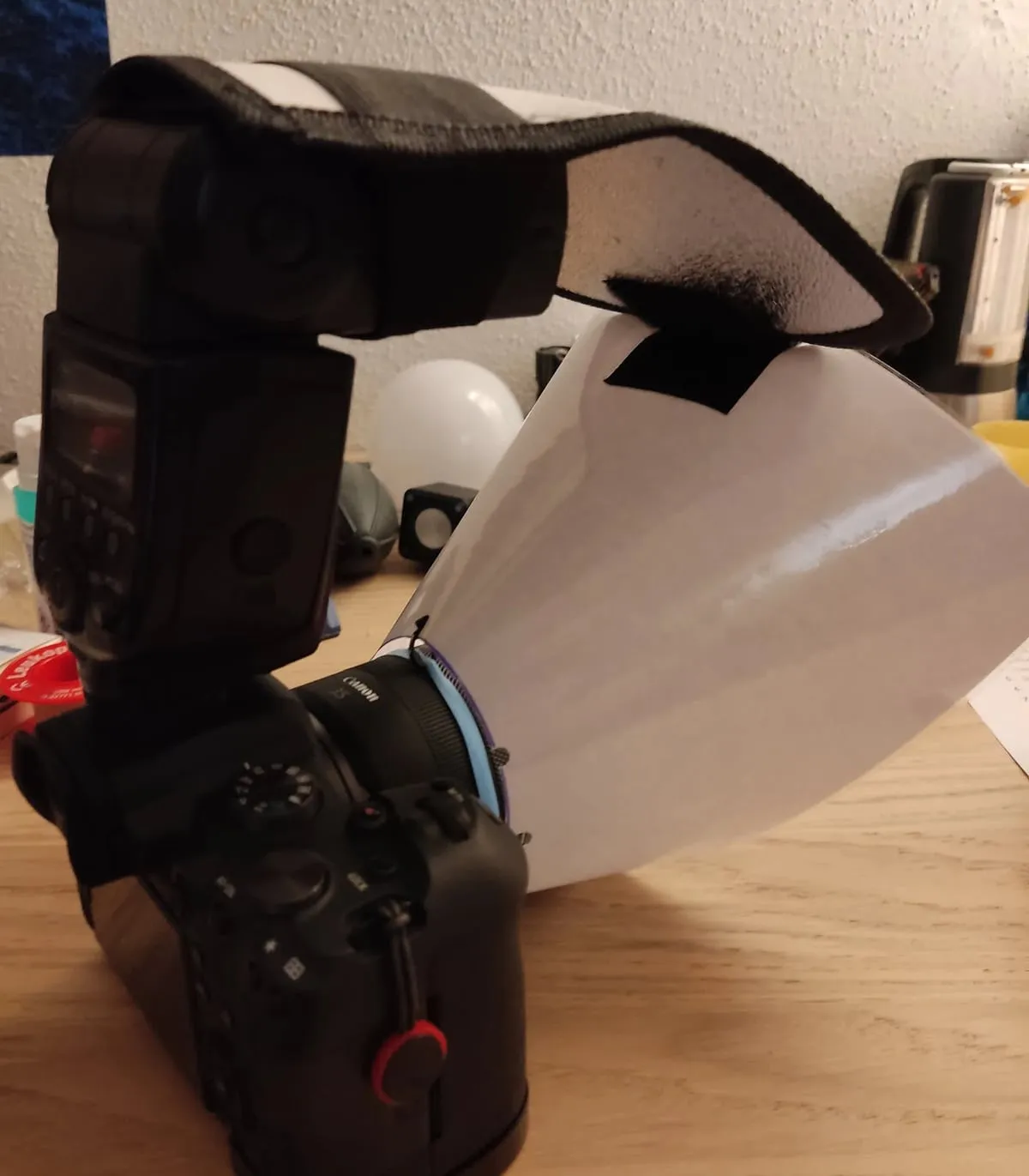
This is the setup the tulips on black were made with. The flash head points upwards. A flexible reflector, black outside and white inside, is attached to the flash with hook-and-loop tape and bounces the light forward into a funnel of white, translucent plastic sheet. The funnel is held on the front of the lens by a ring. The light then comes from a large, bright area all around the front element, right in front of the flower.
Crisps tube on the EF 100 mm Macro
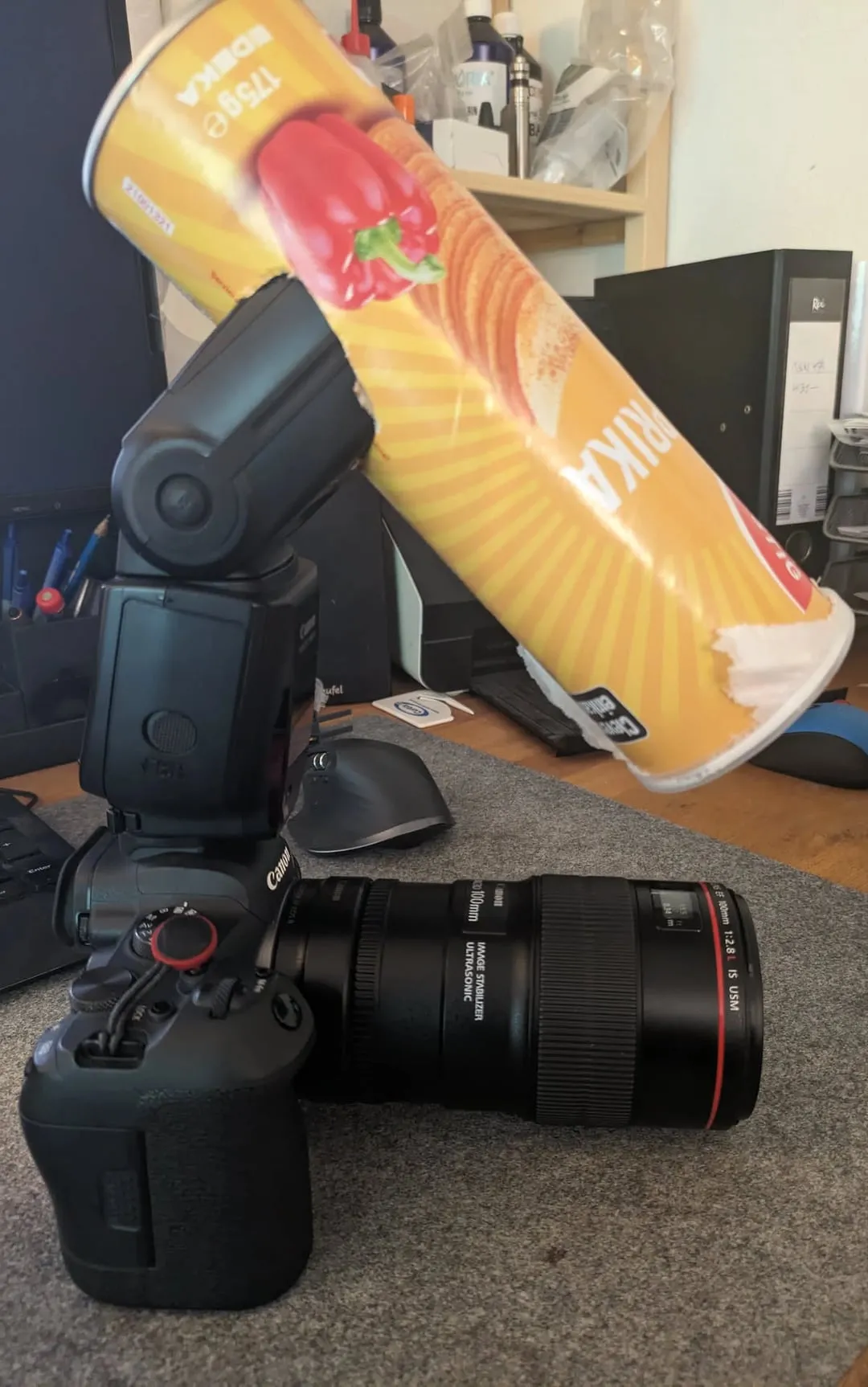
On the longer EF 100 mm Macro the front of the lens sits far ahead of the flash. Here an empty crisps tube fits over the flash head and channels the light forward over the lens. The inside of these tubes is usually coated and reflects well. For even softer light, cover the opening at the front with baking paper or white plastic sheet.
More tips
- Background: the further away it is, the blacker it gets. Often it’s enough to hold the camera a little higher or lower.
- Water drops: a spray bottle gives the petals drops that sparkle in the flash.
- No tripod needed: the flash burst is much shorter than 1/250 s and freezes small movements. Focus is the harder part: at f/16 and this close, only a narrow zone is sharp.
- Editing: if some of the background still shows, lower the blacks slightly in Lightroom or darken the background with a mask.
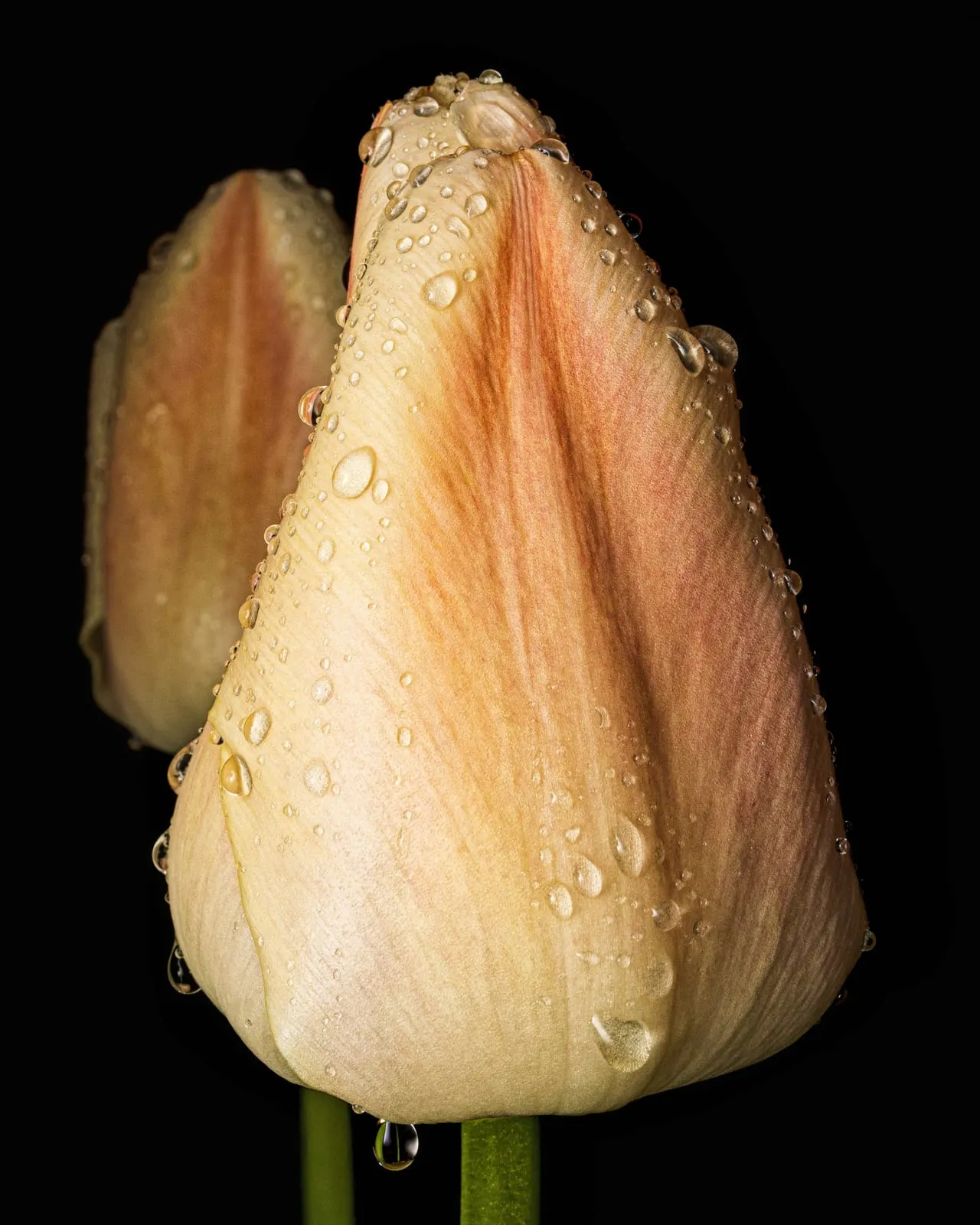 Tulip buds with water drops · 1/250 s · f/16 · ISO 100
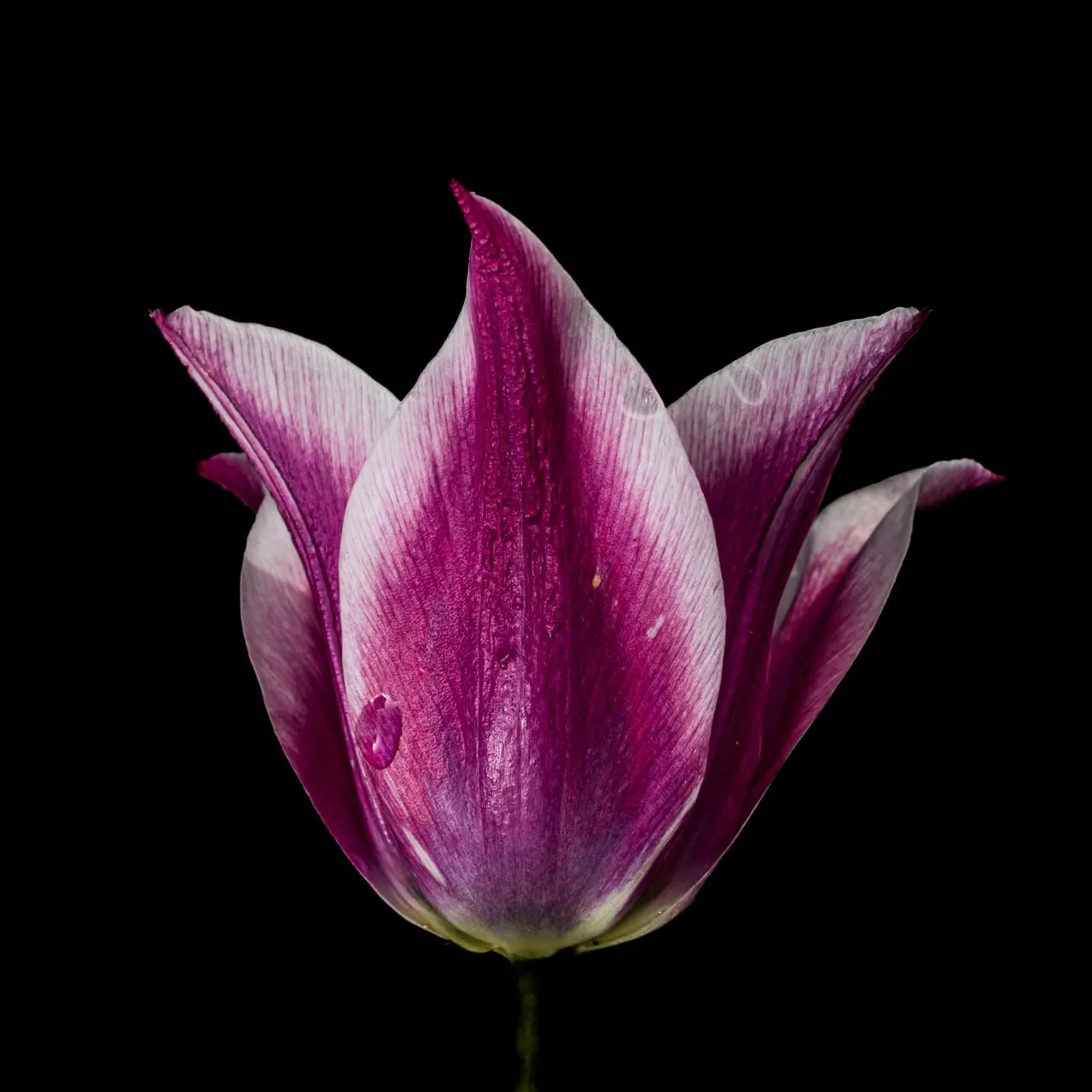 Purple and white tulip, Weihenstephan Trial Garden · 1/250 s · f/18 · ISO 100
You’ll find all the photos in the Flowers series.